Loading...

01 What is VWAP?
Definition
Volume Weighted Average Price (VWAP) calculates the average price of an instrument throughout a session, weighted by the volume traded at each level. Unlike a simple moving average that treats every price equally, VWAP gives more weight to prices where more contracts changed hands. The result is a single line that represents where the market actually facilitated the most trade. It's a simple concept.
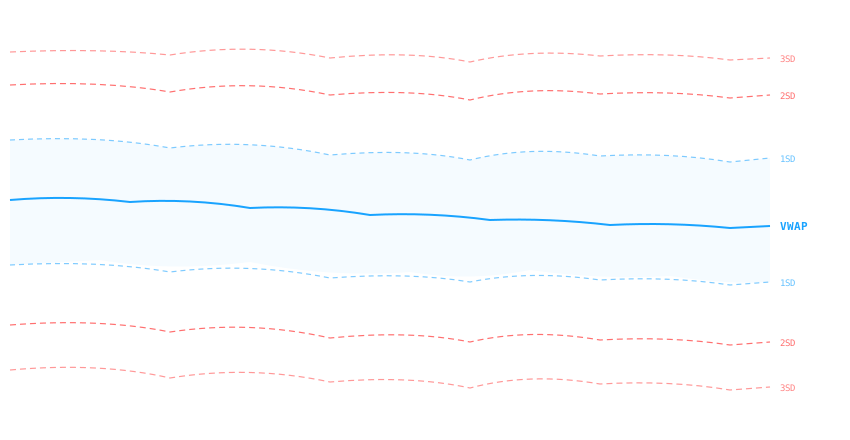
VWAP Overview • Source: orderflw.com
The Formula
The VWAP is calculated using the following formula: VWAP = Σ (Typical Price x Volume) / Σ Volume.
The calculation resets at the start of each session and accumulates from there. Early in the session, when cumulative volume is low, a single trade can move VWAP significantly. As the session matures, VWAP stabilizes and becomes harder to shift. This is why VWAP tends to flatten out toward the end of the day.
02 VWAP as a Reference Level
Above and Below VWAP
The position of price relative to VWAP provides immediate context about intraday sentiment. When price trades above VWAP, the average buyer for the session is in profit, buying interest has been dominant, and sustained trading above confirms bullish intraday bias. When price trades below VWAP, the average buyer is underwater, selling pressure has been more dominant, and sustained trading below confirms bearish bias. When price is at VWAP, neither side has an advantage and the market is in balance. These conditions shift throughout the day. A market trading above VWAP for hours may suddenly break below, signaling a change of control. How price interacts with VWAP, whether it accepts or rejects the level, reveals evolving market dynamics.
VWAP and Auction Market Theory
From an AMT perspective, VWAP represents the session's developing fair value. Just as Volume Profile identifies fair value through volume concentration at price, VWAP identifies it through the cumulative volume weighted average. Both answer the same question: where is the market facilitating the most efficient trade?
Near VWAP, the market is balanced. Away from VWAP, it is in imbalance. This makes VWAP a natural complement to Volume Profile and TPO. Volume Profile shows the structural distribution of value. VWAP provides a dynamic, real time reference that evolves with the session.
03 Standard Deviation Bands
Overview
VWAP with Standard Deviation Bands • Source: orderflw.com
Standard deviation bands around VWAP measure how far price has deviated from the session's average. They are mathematically derived from the actual distribution of traded prices and expand during volatile conditions and contract during calm ones. Treat the bands as probability zones, not certainties.
The Bands
You can configure as many deviation bands as you want, but the most commonly used are the first three. Approximately 68% of the session's price activity falls within the 1SD bands, meaning the market is operating within a normal range. In balanced sessions, 1SD levels often act as soft boundaries where mean reversion begins, while in trending sessions price can ride along 1SD for extended periods. The 2SD bands capture approximately 95% of price activity. Reaching 2SD represents a significant extension from fair value and the market is statistically stretched. In balanced sessions this often coincides with exhaustion, while in strong trends 2SD may be reached and sustained. The 3SD bands capture approximately 99.7% of all trading and are rarely reached. Price at 3SD typically only occurs during strong imbalances or discovery phases where one side has taken full control of the auction. These levels frequently mark turning points where exhaustion sets in and the statistical odds favor a rotation back toward VWAP.
04 VWAP in Different Market Conditions
Balanced Markets
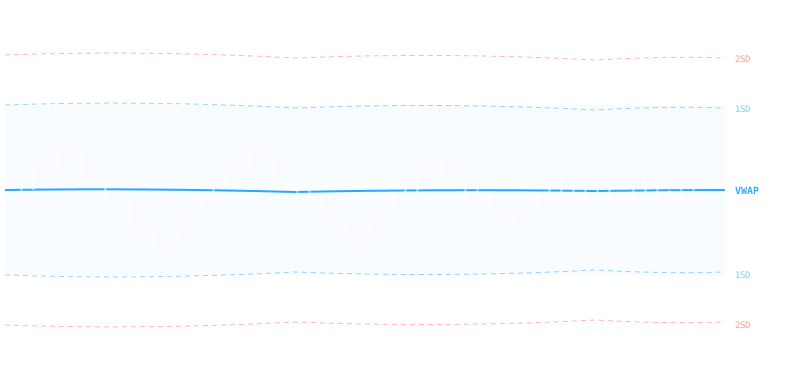
VWAP in Balanced Markets • Source: orderflw.com
In balanced or range bound sessions, VWAP acts as the equilibrium. Price repeatedly returns to VWAP after testing the extremes, creating a rotational pattern. The VWAP line itself stays relatively flat. The key principle: price trading far from VWAP in a balanced market is statistically likely to return to the average. The 1SD bands define where "far" is in objective terms.
Trending Markets
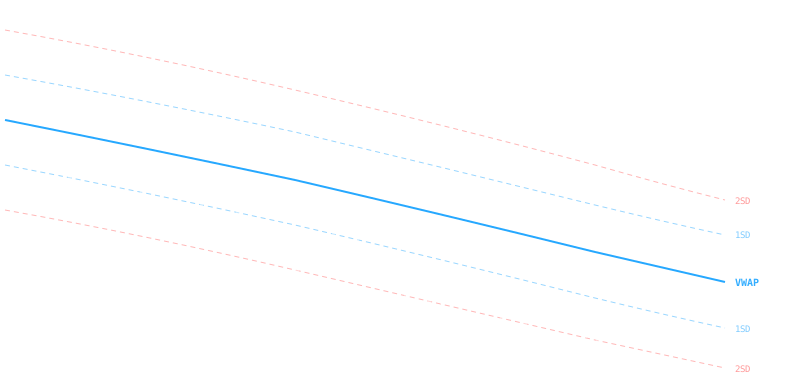
VWAP in Trending Markets • Source: orderflw.com
In trending or discovery markets, VWAP acts as dynamic support or resistance rather than a mean reversion target. Price tends to grind along the 2nd or 3rd deviation bands as one side maintains full control of the auction. In these conditions, pullbacks to the 1st deviation band often provide high probability continuation entries in the direction of the trend. Do not fade a trend day just because price has reached the 2nd or 3rd deviation. The market can stay at extremes far longer than expected when initiative activity is driving the auction, and counter-trend entries on trend days are one of the fastest ways to take unnecessary losses. The slope of VWAP confirms the trend: a flat VWAP suggests balance, a clearly sloping VWAP confirms directional activity. Recognizing whether the market is balanced or trending is essential for applying VWAP correctly, because the same level can be a mean reversion opportunity in one context and a trend continuation level in another.
05 Anchored VWAP
Definition
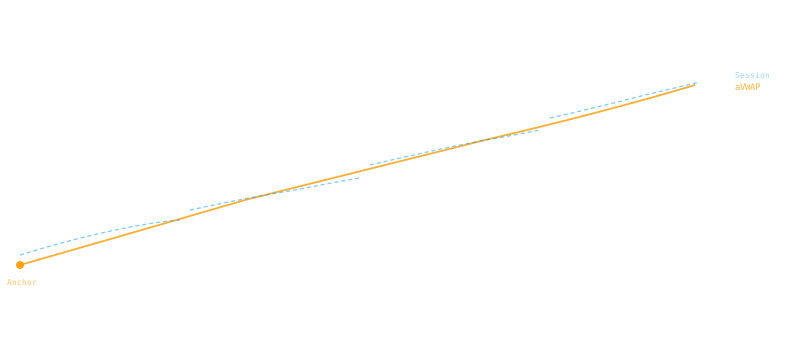
Anchored VWAP • Source: orderflw.com
Anchored VWAP (aVWAP) uses the same formula as standard VWAP but lets the trader choose the starting point instead of defaulting to the session open. This means it can span days, weeks, months, or even years, making it a powerful tool for understanding the average cost basis of participants who entered after a specific event or price level.
Common Anchor Points
Common anchor points include significant swing highs and lows, session opens, earnings or macro events, gap opens, breakouts from consolidation, and weekly, monthly, quarterly, or yearly opens. Anchoring to a swing low, for example, reveals where the average buyer accumulated during the rally that followed. If price pulls back to that level, the average buyer is approximately break even, which makes it a psychologically and structurally significant zone. When multiple anchored VWAPs converge at similar prices, the resulting confluence carries significantly more weight than any single level and often attracts meaningful orderflow when tested.
06 Multiple Timeframe VWAP
Overview
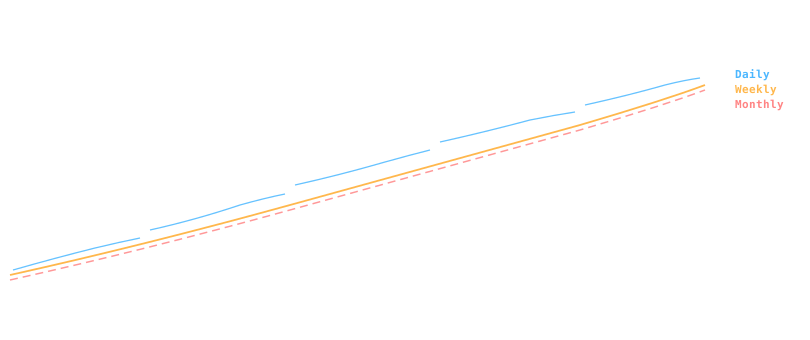
Multiple Timeframe VWAP • Source: orderflw.com
VWAP can be applied across multiple timeframes, each operating independently with its own cumulative data. Daily VWAP resets each session and is the primary intraday reference, though some traders also use an RTH-only VWAP that excludes overnight activity and resets at the regular trading hours open. Weekly VWAP accumulates from Monday's open and reflects the week's average, providing broader context for swing trading decisions. Monthly VWAP accumulates from the first trading day of the month and serves as a higher timeframe benchmark used by longer term participants.
Confluence
When daily VWAP, weekly VWAP, and an anchored VWAP align at similar prices, the combined weight creates a high probability decision point. A breakout above both daily and weekly VWAP carries more significance than a daily VWAP breakout alone. Similarly, support where multiple VWAP references converge provides stronger evidence that the level will hold.
07 YouTube Videos
VWAP Explained
VWAP Trading
Advanced VWAP
Test Your Knowledge
1 / 5What makes VWAP different from a simple moving average?