Loading...

What is Auction Market Theory?
Definition
Auction Market Theory (AMT) is a framework for understanding how financial markets operate at their most basic level. It explains how markets seek fair value through the continuous interaction of buyers and sellers. AMT is not a trading strategy, but a lens through which market behavior can be observed and understood. From this perspective, financial markets move higher or lower as a result of imbalances in buyer and seller aggression, often driven by market events, until price reaches a level where that aggression becomes balanced and the greatest amount of trade can occur. This level of balance represents fair value.
Understanding Fair Value
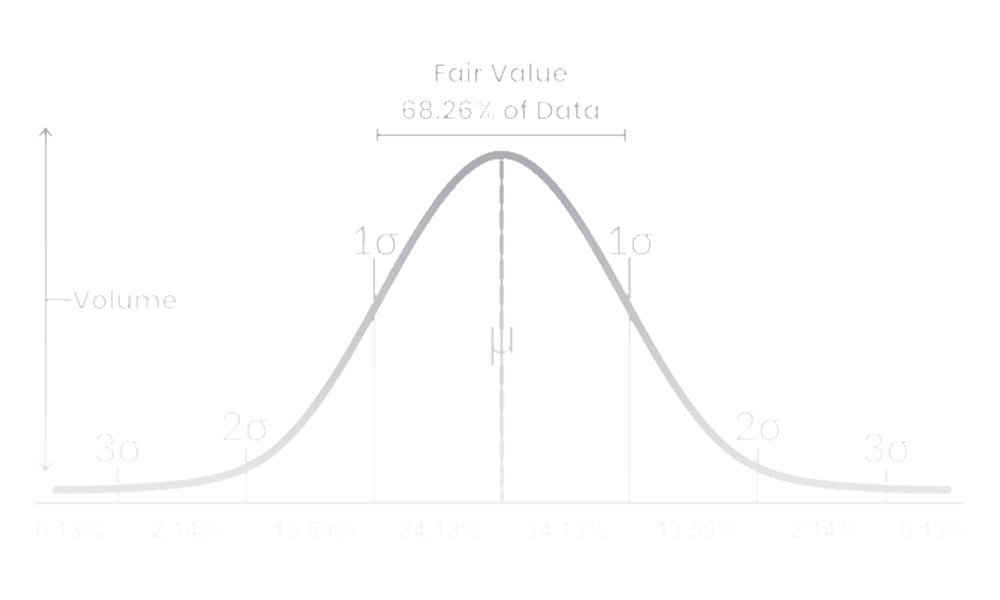
Fair Value Distribution • Source: orderflw.com
Fair value refers to the price area that facilitates the greatest amount of trade between market participants. At fair value, buyer and seller aggression are closely balanced, resulting in price trading within a relatively tight range while volume remains elevated. When a market is trading at fair value, it is considered to be in a state of balance.
Within the Market Profile framework, traditionalists define fair value as the area containing approximately 70% of a session’s total volume, rather than the statistically derived 68.2%. The point of control serves as the mean of this value area and represents the price level where the highest level of trading activity occurred.
Prices that trade above or below this high-volume fair value area are considered “unfair” prices, as they reflect levels where participation is reduced and the market is not efficiently facilitating trade or accurately reflecting the security’s true value.
The Auction Cycle
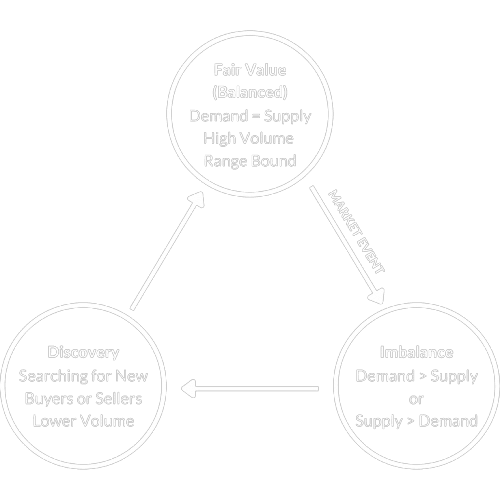
The Auction Cycle • Source: jumpstarttrading.com
The auction cycle describes how financial markets continuously transition between balance and imbalance as they seek fair value. When price is trading within a fair value area, buyers and sellers are largely in agreement on price. In this balanced state, participation is high, volume is elevated, and the market efficiently facilitates trade. Price typically remains range-bound as the greatest amount of trading activity occurs.
This balance can be disrupted by a market event or a shift in participant behavior, creating an imbalance between supply and demand. As buyer or seller aggression begins to dominate, price moves directionally away from the established fair value area. During this phase, some participants withdraw as price no longer represents fair value to them, leaving only more aggressive buyers or sellers willing to transact at increasingly higher or lower prices.
As price moves further away from fair value, the market enters a discovery phase. In discovery, the auction is searching for the next price level where participation can increase and balance can be restored. Volume typically declines as price explores areas of lower acceptance. Once the auction reaches an extreme, where participation is minimal, the market begins to rotate back toward prior areas of balance. Historically, this rebalancing process results in a high probability, often referenced as approximately 80%, that price will revisit the previous value area. The logic behind this tendency is explained later.
When buyer and seller aggression once again align and participation increases, a new fair value area is established. At this point, the market has completed one full auction cycle and returned to an efficient, balanced state. This cycle repeats continuously as markets respond to new information and changing participant behavior.
Key Components of AMT
Balanced Auction ➥ Ranging Market
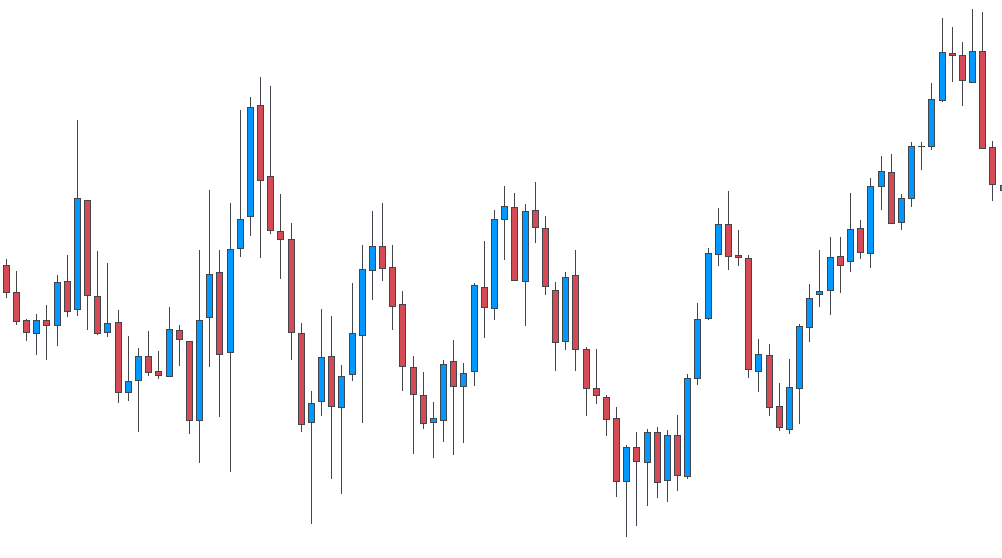
Balanced Auction • Source: orderflw.com
A Balanced Auction describes a market environment in which price is being actively accepted by participants over time. In this condition, the market is not attempting to move price higher or lower, but instead focuses on facilitating trade at currently accepted levels. The defining characteristic of a balanced auction is sustained two-sided activity, where both buyers and sellers are willing to transact without requiring meaningful price movement.
Balanced auctions often develop after the market has completed a phase of price discovery. Once directional activity subsides and aggressive participants withdraw, the remaining participants transact around prices they collectively perceive as acceptable. This results in stable market behavior, where price movement is driven more by time and participation than by directional intent.
From an analytical perspective, balanced auctions are important because they establish reference areas. These areas provide context for future market activity, as they represent zones of prior agreement. When price later returns to a previously balanced area, the market will often either accept or reject these levels based on prior participation. Because of this clear behavioral response, balanced areas frequently provide high-quality reference points for generating trade ideas.
Balanced auctions also play a key role in risk definition. Because price movement is rotational and bounded, market behavior becomes more structured and predictable in terms of range. This makes balanced conditions especially useful for understanding where initiative activity may begin if balance is disrupted.
While a balanced auction reflects market agreement, it is inherently temporary. Markets remain balanced only until new information, shifting expectations, or renewed participation creates sufficient pressure to move price away from acceptance and initiate a new auction phase.
Imbalanced Auction ➥ Trending Market
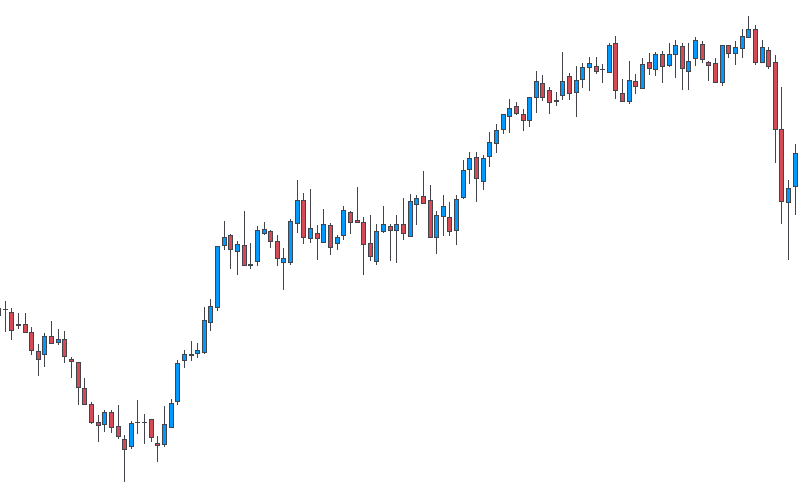
Imbalanced Auction • Source: orderflw.com
An Imbalanced Auction describes a market environment in which price is no longer being efficiently accepted and one side of the market becomes dominant. In this condition, the market is not focused on facilitating trade, but on moving price in order to resolve disagreement. Participation becomes uneven as aggressive buyers or sellers are willing to transact at increasingly higher or lower prices.
Imbalanced auctions typically emerge when new information, shifting expectations, or strong initiative activity enters the market. As price moves away from prior areas of acceptance, participation thins and transactions occur at fewer price levels. This behavior reflects urgency rather than agreement, with market participants prioritizing execution over price efficiency.
From an analytical perspective, imbalanced auctions are important because they redefine value. The directional movement establishes new reference levels and exposes areas where the market has little prior acceptance. These zones often act as decision points in future trading, as price may either continue through them with little resistance or react sharply when participation reappears. During trending market conditions, traders typically focus on aligning with the prevailing direction of the auction, as following the trend reflects the dominant market intent until balance begins to return.
Imbalanced conditions also offer insight into market intent. Sustained directional movement suggests that the market is actively searching for a new area of balance. When price begins to slow, rotate, or attract increased participation, it often signals that the imbalance is weakening and a transition toward balance may be underway.
Although imbalanced auctions can persist for extended periods, they are not permanent. Once urgency diminishes and participation broadens, the market naturally shifts back toward a more balanced state, completing the auction process and setting the stage for the next cycle.
Market Auctions ➥ Conclusion
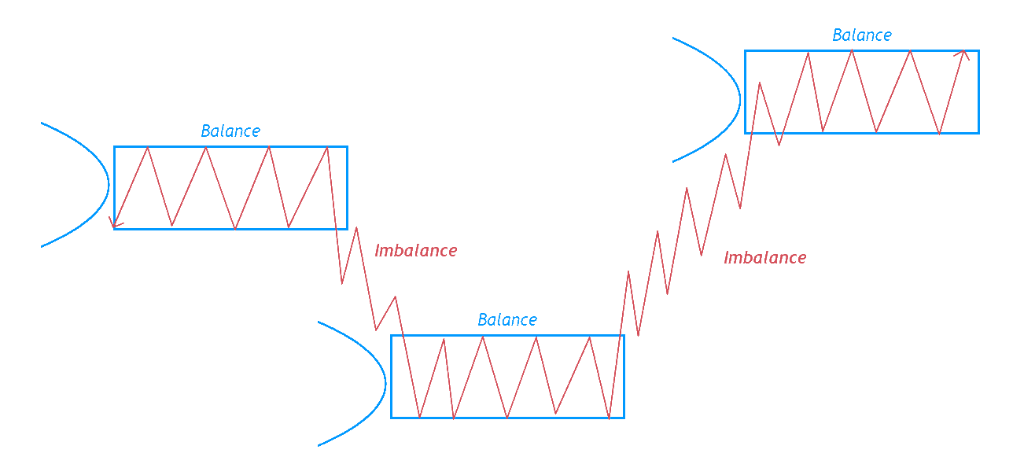
Market Cycle Structure • Source: orderflw.com
Understanding market auctions begins with identifying whether the market is operating in balance or imbalance, as each condition reflects a different phase of the auction process. Traders must first determine whether price is being accepted or whether the market is actively searching for new value, since behavior, participation, and intent vary significantly between these states. This contextual understanding forms the foundation for effective market analysis. In terms of AMT, the market is always cycling from balance to imbalance to balance to imbalance to balance, and so on. In the following sections, we will explore different Auction Market Theory scenarios to demonstrate how these auction conditions unfold in practice.
Visualizing of AMT
Eyeballing ➥ Candlesticks
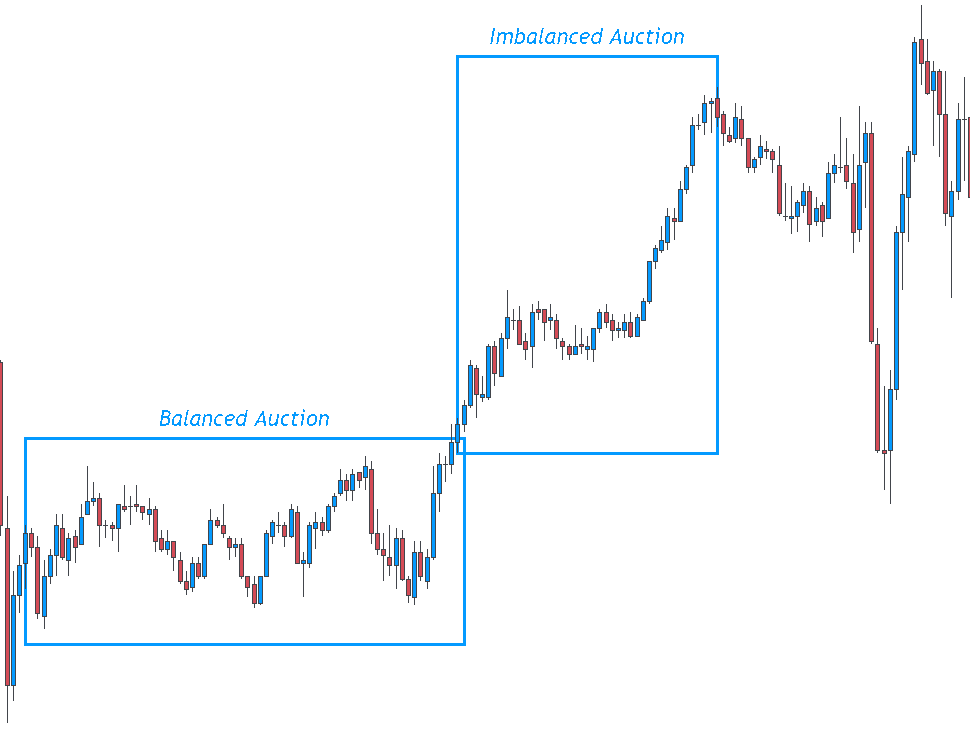
Eyeballing AMT • Source: orderflw.com
“Eyeballing” Auction Market Theory refers to visually assessing market behavior, often using candlestick charts, without applying real market profiles such as Time Price Oppurtunity or Volume Profile. This approach can be useful for developing an initial sense of market context, such as whether price appears rotational or directional, or whether recent movement suggests balance or imbalance.
For newer traders, eyeballing can help build intuition and improve familiarity with price behavior. It encourages observation of market structure, tempo, and general participation, which are foundational skills in understanding auctions. In some situations, a quick visual assessment may also provide a high-level overview of current market conditions.
However, relying solely on visual interpretation has significant limitations. Without objective reference points, such as clearly defined value areas or acceptance and rejection levels, subjective bias can easily influence conclusions. What appears balanced or trending at first glance may not accurately reflect underlying market participation. As a result, eyeballing often leads to inconsistent analysis and makes it difficult to distinguish meaningful auction behavior from noise.
While visual observation can complement Auction Market Theory, it should not replace structured analysis. AMT is most effective when supported by objective data that defines balance, imbalance, and participation. Eyeballing may offer a starting point, but without deeper context, it provides an incomplete and potentially misleading view of the auction process.
Volume Profile
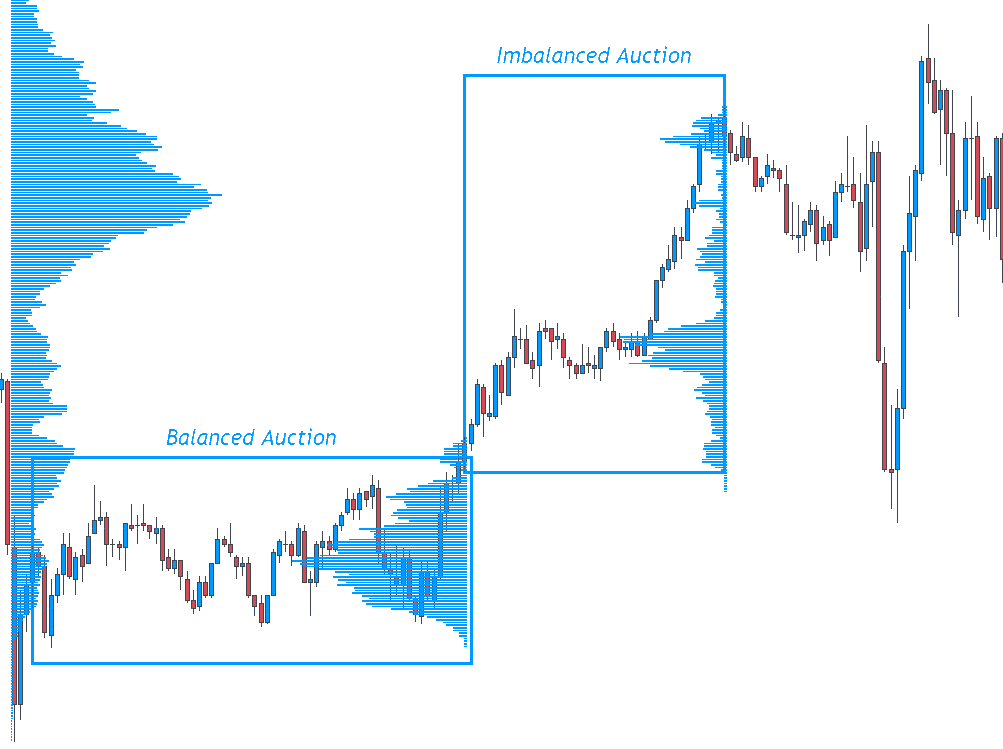
Volume Profile AMT • Source: orderflw.com
Volume Profile provides a structured and highly effective way to visualize Auction Market Theory by organizing traded volume across price levels. Rather than focusing solely on price movement, it reveals where the market has facilitated the most volume and where participation has been limited. This makes Volume Profile particularly well suited for identifying fair value, balance, and areas of price acceptance or rejection.
By aggregating volume over a defined number of price increments (ticks), Volume Profile highlights how market participants interact with price. Areas within value naturally accumulate higher volume, as buyers and sellers are in agreement and able to transact efficiently. Outside of value, participation decreases, volume thins, and price tends to move more quickly due to reduced agreement between buyers and sellers.
High Volume Nodes (HVNs) represent price areas where a significant amount of volume has previously been traded and therefore reflect fair value. These zones form when the market spends time facilitating trade at prices broadly accepted by participants. Because HVNs are derived from sustained participation, they serve as important reference areas within the auction process. When the market revisits a high-volume node, price often responds by either accepting the area, leading to rotation and balance, or rejecting it and returning to discovery.
In contrast, Low Volume Nodes (LVNs) highlight price areas where little volume has been traded, indicating a lack of agreement between buyers and sellers. These zones typically form during imbalanced auctions, when price moves rapidly through levels in search of participation. LVNs visually represent areas of rejection and often separate regions of balance. When revisited, they tend to act as areas of fast price movement, reflecting the market’s tendency to move quickly through prices where acceptance has previously been low.
Beyond HVNs and LVNs, Volume Profile establishes additional objective reference points such as value areas and points of control. Together, these levels create a consistent framework for analyzing how the market interacts with value and transitions between balanced and imbalanced conditions. Because all of these references are derived directly from traded volume, they align closely with the core principles of Auction Market Theory.
Overall, Volume Profile serves as a powerful visualization of the auction process. It brings clarity, structure, and precision to market analysis, helping to explain how price moves, where value is formed, and how markets alternate between balance and discovery.
Time Price Opportunity
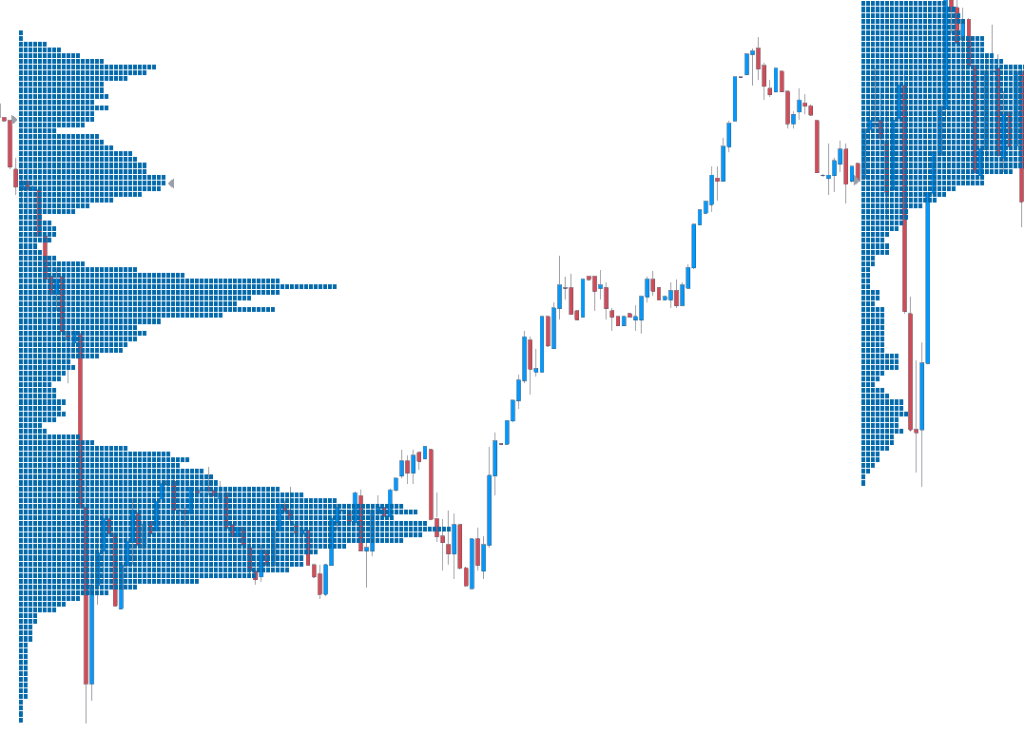
Time Price Opportunity AMT • Source: orderflw.com
Time Price Opportunity (TPO) provides a structured way to visualize Auction Market Theory by organizing market activity based on time spent at price rather than traded volume. Instead of highlighting where the most volume occurred, TPO reveals where the market accepted price long enough to facilitate repeated trading, offering insight into areas of agreement and disagreement among participants.
By aggregating price activity over fixed time intervals, TPO illustrates how the market interacts with price throughout the session. Areas where price remains for extended periods reflect acceptance and balance, while prices visited briefly indicate rejection. This allows traders to objectively assess whether the market is operating in balance or actively moving through price in search of new value.
In TPO-based analysis, high TPO counts represent price areas where the market spent considerable time, indicating strong acceptance and prior value. These areas often form around the center of the distribution and serve as important reference points within the auction. When the market revisits such areas, price frequently slows or rotates as participants re-engage at levels that were previously accepted.
In contrast, low TPO areas highlight prices where the market spent little time, reflecting rapid movement and limited agreement. These zones typically form during imbalanced auctions, when price moves quickly in response to initiative activity. Low TPO areas visually separate regions of balance and often act as areas of swift price movement when revisited, as the market tends to reject prices that were not previously accepted.
Beyond individual TPO levels, the overall TPO distribution establishes additional reference points such as value areas and points of control. Together, these elements provide a consistent framework for analyzing how the market transitions between balance and imbalance. Because TPO is based on time rather than volume, it offers a complementary perspective on the auction process while remaining fully aligned with the principles of Auction Market Theory.
Overall, Time Price Opportunity serves as a powerful visualization of market acceptance and rejection. It brings structure and clarity to auction analysis by showing where price was accepted over time and where it was not, helping traders better understand how markets move between balance and discovery.
More detailed information on TPO concepts and applications can be found in the Market Profile section.
Visualizing of AMT ➥ Conclusion
Auction Market Theory can be interpreted through several visualization methods, each offering a different level of clarity and structure.
Eyeballing price action provides a fast and intuitive overview of market behavior, allowing traders to sense balance, imbalance, and momentum directly from price movement. While useful for developing market feel, this approach remains subjective and lacks precise reference levels.
Volume Profile introduces a more objective framework by organizing traded volume across price levels. It clearly reveals where the market has accepted price, where value has formed, and where imbalances have occurred. High-volume and low-volume areas provide reliable reference points that align closely with the core principles of AMT, making it easier to assess market state and anticipate potential responses.
Time Price Opportunity adds another layer of structure by emphasizing time spent at price rather than volume. This perspective helps visualize how long the market has accepted certain prices, offering deeper insight into market development, balance, and value distribution.
Together, these visualization methods allow traders to progressively refine their understanding of the auction process. By combining intuition with objective market structure, traders can more effectively identify whether the market is balanced or imbalanced and how price is interacting with value as the auction evolves.
How the Auction Unfolds
Acceptance of Value
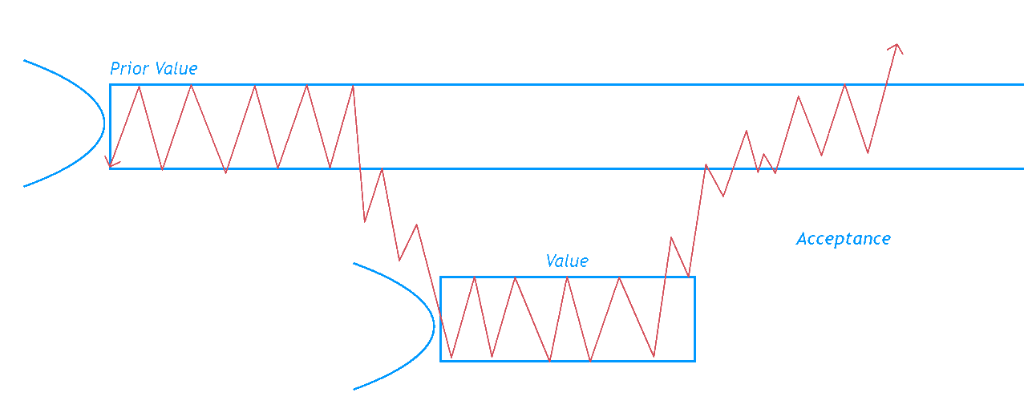
Acceptance of Value • Source: orderflw.com
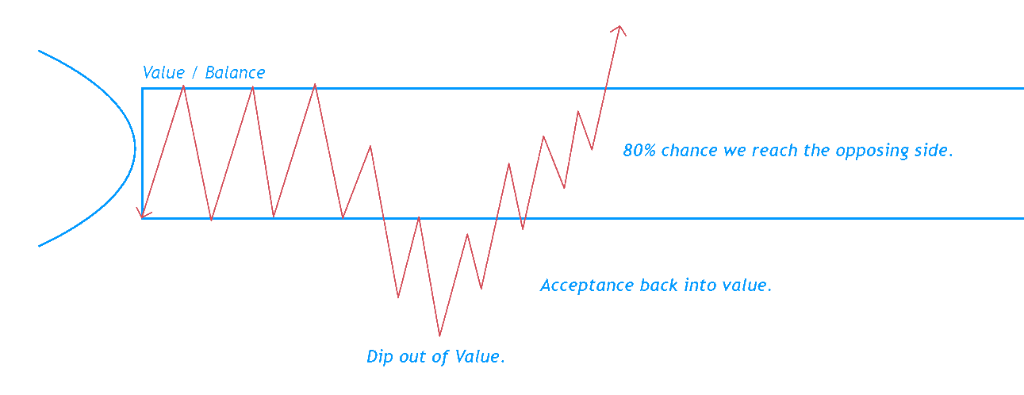
Acceptance 80% Rule • Source: orderflw.com
Acceptance of value describes a condition in which the market recognizes a price area as fair, often prior value or former balance areas where agreement previously existed, and is willing to conduct business there by accepting price back into balance. When value is accepted, both buyers and sellers actively participate, resulting in increased volume and rotational price behavior.
In the first illustration, price departs from a prior value area and moves into a new price zone. After a period of imbalance, participation increases and price begins to rotate and balance within this new region. This behavior indicates that the market has discovered a new level where buyers and sellers agree on price, leading to the formation of a new value area. Price then rotates back toward the prior value area and is accepted into it.
The second illustration highlights the commonly referenced 80% rule within Auction Market Theory. When price briefly dips outside of an established value area but fails to attract sustained participation, acceptance returns. As a result, price rotates back into value and, historically, has a high probability of traversing the value area toward the opposite side.
Rejection of Value ➥ Failed Auction
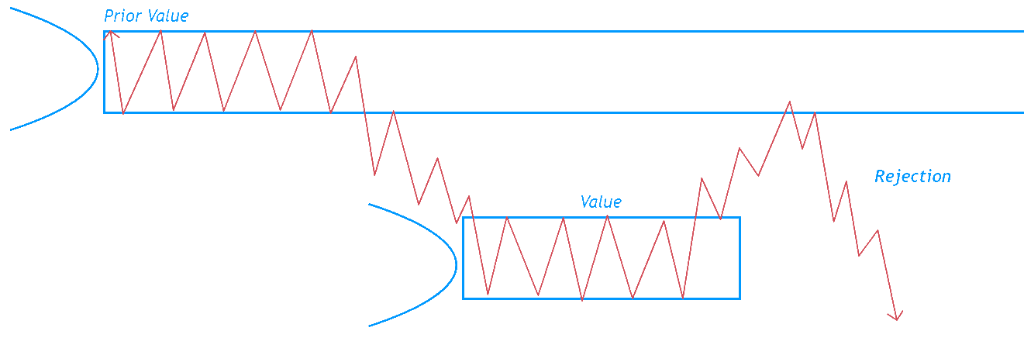
Rejection of Value • Source: orderflw.com
Rejection of value occurs when the market tests a price area but fails to attract sufficient participation to sustain trade at that level. Unlike acceptance, rejection signals disagreement among market participants, resulting in swift directional movement away from the tested prices. These areas are typically associated with low participation and inefficient trade.
In the illustration, price transitions from a prior value area into a new value region, where balance is temporarily established. As the market later revisits the prior value area, participation fails to increase and price is unable to rotate or stabilize. This lack of acceptance leads to rejection, with price moving quickly away from the area.
Rejection often results in sharp, directional movement as the auction searches for prices where agreement can be restored. These rejected zones frequently become important reference levels in future trading, as the market tends to respond decisively when they are approached again.
AMT Scenarios
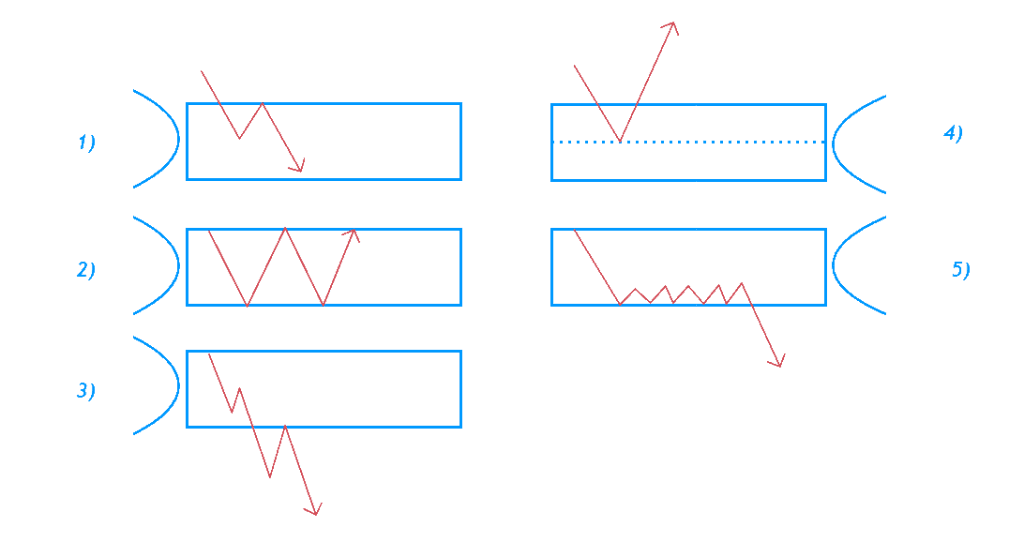
AMT Scenarios • Source: orderflw.com
AMT Probabilities
Markets are balanced approximately 70-80% of the time, making balance the most common market condition. As a result, when price reaches the extremes of an established value area, it is statistically more likely to remain within balance and rotate rather than immediately break out. However, these probabilities are dynamic and can change when new information or strong initiative activity appears. For this reason, balance expectations should always be validated with real-time participation and volume behavior.
When balance breaks and price moves outside of value, the auction enters a new decision phase. At this point, the immediate probabilities tend to split more evenly, with roughly a 50/50 chance of continuation in the breakout direction or rotation back into value.
If price returns and accepts back into value, the probabilities shift again. There is approximately a 20% chance the market will simply range and build additional volume within value (a failed auction), and an approximately 80% probability that price will rotate through value toward the opposite end of balance, completing the auction.
Example
Example ➥ Schematic
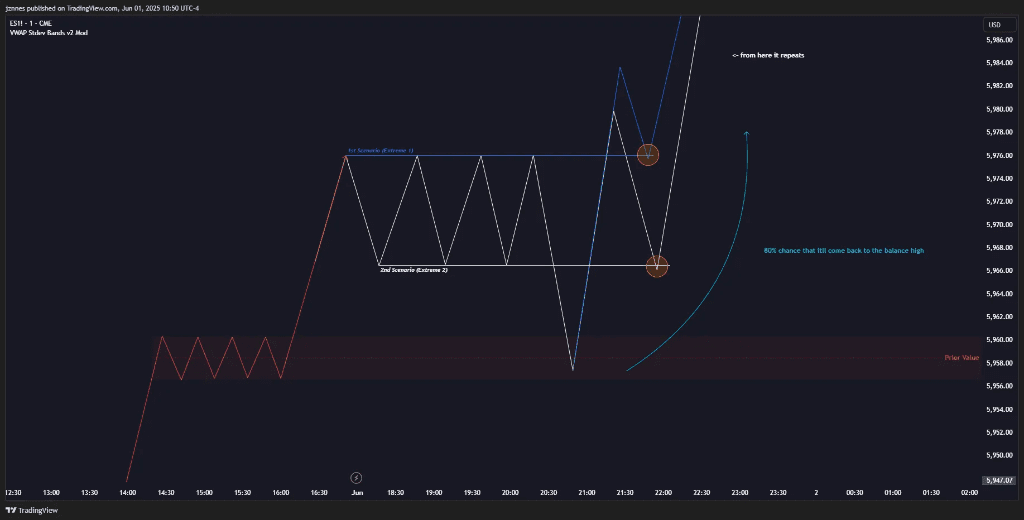
Auction Schematic • Source: orderflw.com
Example ➥ Trade
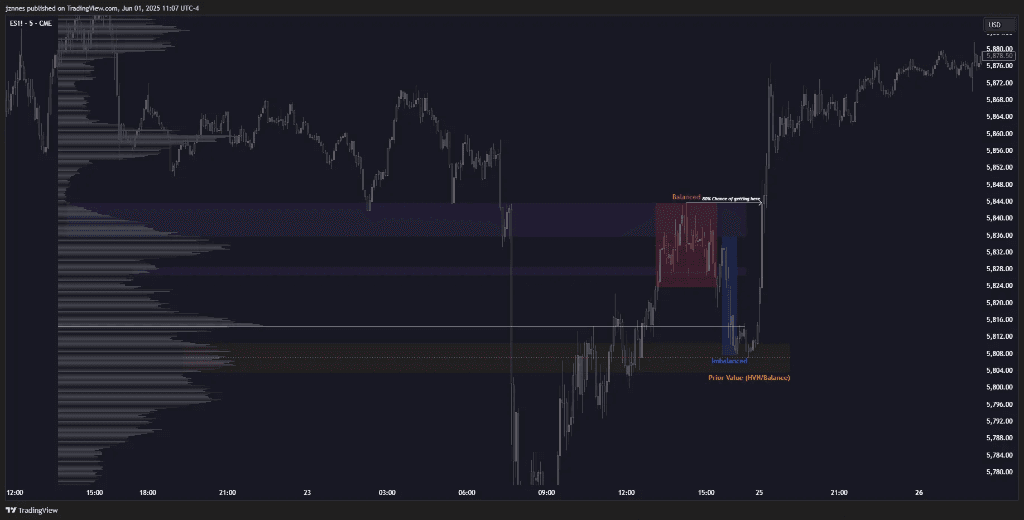
Auction Trade • Source: orderflw.com
YouTube Videos
The Basics of Auction Theory
Understanding Balance & Imbalance
Trading the Auction Process
Interactive: The Auction Cycle
Click the buttons below the chart to see how markets move from balance to imbalance and back again.
Click a button below the chart to understand the full auction cycle.
Test Your Knowledge
1 / 5What does Auction Market Theory primarily describe?